Which Products Seem Simple But Are Actually Very Difficult to Mold?
Many buyers and new engineers assume certain plastic parts look straightforward to produce. In fact, products seem simple but are actually very difficult to mold in real‑world injection‑molding workshops. Although these items feature basic geometry without complex structures, they bring huge debugging challenges for mold makers. Below are six typical categories of these tricky plastic products.
Products Seem Simple But Are Actually Very Difficult to Mold: Core Reasons
When we talk about products seem simple but are actually very difficult to mold, we are referring to parts with plain geometry that hide severe manufacturing risks. Parts without patterns, ribs or grooves cannot hide molding defects. Any tiny error in filling, venting, cooling or ejection will show directly on finished surfaces. Mold makers must pursue ultra‑high precision for these “easy‑looking” components. Let’s walk through each typical product group.
- Ultra‑thin Flat Sheets
Products such as gaskets, dust‑proof films, and thin plastic sheets are often perceived by laypeople as easy to mold—they’re thin, have no holes, no complex shapes, and require no assembly, so it seems like any flat mold could be used to produce them. Ultra‑thin flat sheets are classic examples where products seem simple but are actually very difficult to mold.
In reality, however, ultra‑thin sheets are widely recognized as the “ultimate challenge” in injection molding.
The vast majority of these sheets are only 0.3 mm to 0.8 mm thick. With such thin material, the resistance to molten plastic flow is extremely high; even a slight fluctuation in flow rate can result in incomplete filling, short shots, or scorched edges.
To ensure full filling, manufacturers must increase injection pressure and speed. However, high‑pressure, high‑speed molding brings a whole new set of problems.
The most vexing issue is the vicious cycle of warpage and flash. Without structural support, thin‑wall products cool extremely quickly and unevenly, making them highly prone to overall warping, twisting, and surface irregularities.
More critically, thin‑wall molds impose the most exacting requirements on parting line flatness and vent groove precision.
While a slightly larger gap in a standard mold is no big deal, even the slightest unevenness on the mold surface or an exhaust channel that is just 0.01 mm too wide in a thin‑wall mold will cause the entire batch of products to have flash.
However, if the exhaust channels are designed too tightly, gas will accumulate and burn, preventing the material from filling the mold completely. The entire process relies solely on skilled technicians repeatedly fine‑tuning the mold assembly and polishing the exhaust channels; conducting eight to ten trial runs is the norm, which is both time‑consuming and labor‑intensive.
- High‑Gloss, Completely Flat Covers
Many flat cover plates for home appliances and digital products are square and clean—free of patterns, latches, or grooves—with a high‑gloss, completely flat surface throughout. Customers often assume that since it’s just a flat plate, tooling must be simple, unaware that the cleaner the surface, the more visible any imperfections become. High‑gloss flat covers are another group of products seem simple but are actually very difficult to mold.
Products with textures or contours can conceal minor shrinkage, ripples, and weld lines, but on fully glossy, flat products, even the tiniest flaw is magnified infinitely.
Even the slightest tool mark on the mold, a minor polishing scratch, or an air pocket caused by poor venting will become clearly visible after molding, resulting in an immediate rejection for cosmetic defects.
Furthermore, it is extremely difficult to control shrinkage and warpage in large, flat products. When the material cools and shrinks across a large, uniformly thick surface, there is no balance point for the forces involved, making it easy for the center to bulge, the edges to curl, and the entire part to warp. As a result, dimensional flatness simply cannot meet assembly standards.
The most challenging aspect of these molds is not the difficulty of machining, but the extremely low tolerance for even the slightest detail. They require ultra‑high‑precision polishing throughout the entire process, uniform and symmetrical cooling channels, and precise control of the gate location.
If the gate is even slightly off, there is a slight temperature difference in the cooling channels, or the polishing pressure is uneven, the entire batch of products will be scrapped. Mold repairs can only be made through minute adjustments; there is absolutely no room for drastic overhauls.
- Slender, Rectangular Products
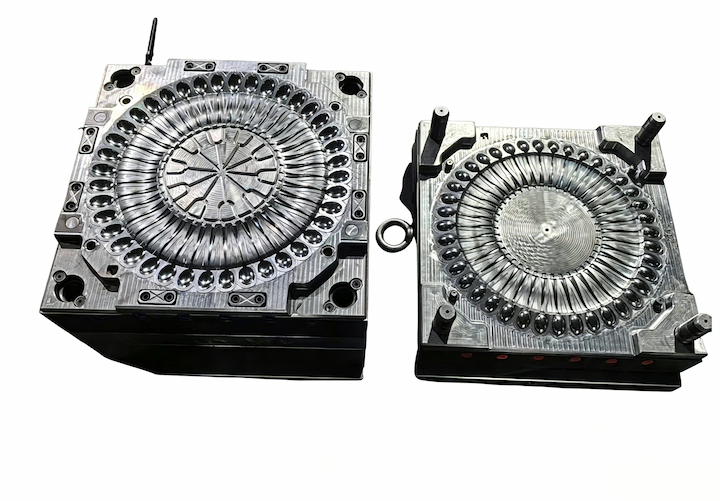
Slender, rectangular plastic parts—long, straight, and structurally simple—may seem straightforward at first glance, but they are among the products mold makers are least eager to take on. There are only two core issues: warping and dimensional deviations in length. These long strips belong to products seem simple but are actually very difficult to mold.
Long, slender products have an extremely high length‑to‑width ratio. When the plastic cools and shrinks, the contraction rates in the transverse and longitudinal directions are completely different, making them inherently prone to bending, twisting, and warping—it’s very difficult to achieve a perfectly straight and flat finish.
No matter how you adjust the machine temperature, injection speed, or holding pressure, it’s difficult to completely eliminate warping issues. Ultimately, most cases require mold modifications, adjustments to the gate location, and pre‑warpage compensation.
At the same time, long strip products demand extremely high temperature uniformity in the mold. Even the slightest temperature difference between the front and back or left and right sides of the mold will cause the products to cool at different rates, immediately resulting in inconsistent lengths and bending or warping.
Furthermore, most of these products are produced using multi‑cavity molds, with multiple products molded per cycle. Achieving consistency across every single product places extremely high demands on the layout of the cooling channels, gate balance, and the flatness of the mold.
What appears to be a simple plastic strip often requires repeated mold modifications to correct the curvature, adjust gate sizes, and optimize the cooling layout—a lengthy process before stable mass production can be achieved.
- Small Round Caps and Lids
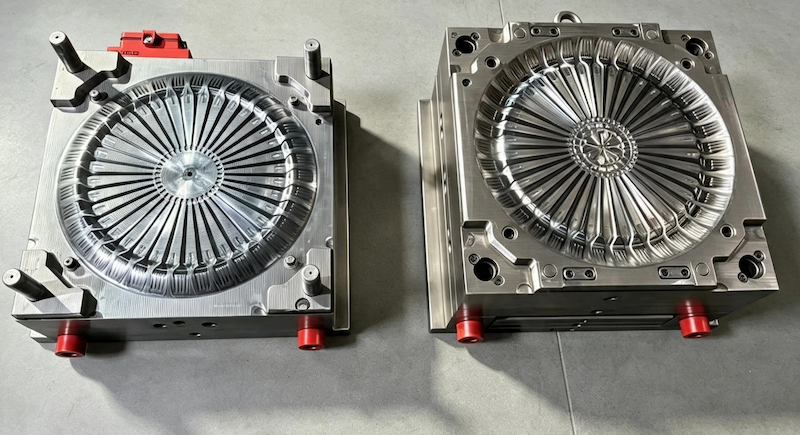
These small, round plastic caps have simple structures, regular shapes, and no complex undercuts. While they appear straightforward, they are a major stumbling block for many novice mold designers. Small round caps are well‑known products seem simple but are actually very difficult to mold.
The biggest challenge with circular products is the difficulty in controlling concentricity and roundness. During mold machining and assembly, even the slightest eccentricity or misalignment can cause the molded cap to become elliptical or have uneven wall thickness. During assembly, this can result in the cap either getting stuck or being too loose with excessive clearance.
Secondly, demolding circular products is extremely prone to problems. Since the entire circumference consists of a continuous curved surface, even a slight deficiency in the demolding angle or a minor flaw in polishing can cause the product to stick firmly to the mold cavity. Forcing it out will inevitably result in white marks, scratches, or deformation.
Furthermore, most round caps are fully encapsulated around the circumference, resulting in particularly poor venting. Air easily accumulates at the top, causing scorching and weld lines that compromise the product’s appearance.
What’s most frustrating is that these small products have an extremely low unit price, yet customers have very high expectations for appearance and dimensions. The time and labor costs involved in mold development and debugging far exceed the value of the product itself—a classic case of “time‑consuming and unrewarding.”
- Thin‑walled, Deep‑cylinder Products
Straight, hollow plastic sleeves—no latches, no steps, no irregular structures—just a straight cylinder that looks to the untrained eye as if it requires no technical expertise. But those in the know understand that the deeper, straighter, and thinner‑walled a tubular product is, the more difficult it is to mold. Deep‑cylinder sleeves are typical products seem simple but are actually very difficult to mold.
First, demolding is extremely difficult.
Due to the product’s great depth and smooth inner walls, the plastic clings tightly to the mold core after cooling and shrinking, creating a very strong grip.
The draft angle cannot be set too steep—if it is, the difference in diameter between the top and bottom of the product will be too great, resulting in a non‑conforming part; if it is too shallow, the product is highly prone to sticking to the mold, tearing the inner wall, and developing scratches or whitening.
Second, there are issues with venting and cooling the inner wall.
Cylindrical products have deep bottoms and enclosed spaces, making it difficult for air to escape. This often leads to problems such as incomplete filling at the bottom, scorching, and air bubbles on the inner wall. At the same time, uneven cooling of the cylinder walls makes it highly prone to defects such as internal shrinkage, overall ovality, and deformation of the end openings.
These molds also require precise control of ejection balance; uneven force on the ejector pins will cause the product to become skewed or the end openings to deform. Every detail must be meticulously controlled throughout the entire process, making the debugging process far more challenging than for ordinary irregularly shaped products.
- Smooth, Solid, Hole‑Free Small Cubes and Plastic Pellets
Finally, there is an extremely unassuming product category: solid plastic cubes, small pellets, and spacers. These are entirely solid, with no holes, grooves, or intricate shapes. While they appear to be the simplest type of mold to produce, they actually hide significant challenges. Solid plastic cubes are also among products seem simple but are actually very difficult to mold.
The biggest problem is that the solid plastic sections are too thick, making shrinkage and sink marks unavoidable. Solid plastic cools slowly, resulting in a large temperature difference between the interior and exterior. This causes significant internal shrinkage, making it easy for the surface to develop sink marks or become pitted.
To mitigate shrinkage, it’s necessary to increase holding pressure and adjust the gate design; however, after adjusting these parameters, flash tends to form along the product’s edges.
Furthermore, solid products have long cooling cycles and slow mass production speeds. Achieving a smooth surface free of shrinkage and flash while maintaining production efficiency requires repeated optimization of the gate design, adjustments to the cooling channels, and fine‑tuning of molding parameters. These seemingly simple blocks often require multiple rounds of trial molding and revisions before they meet the required standards.
Conclusion
As we covered above, products seem simple but are actually very difficult to mold. Visual simplicity never equals easy injection molding production. Flat, slender, thin‑wall or fully solid plastic parts bring huge challenges for filling, venting, warpage control and demolding. Mold engineers should complete risk assessment before starting any tooling work.
Reference: For more detailed plastic material property parameters, please check professional polymer material database
If you want to know more knowledge of molding,you can see the Injection Molding Plastic Material Selection for Mold Design: 7 Practical Tips for Perfect Molds